Guide · Online stores
How to build an online store in Colombia.
From selling on Instagram and WhatsApp to a store that charges, ships and answers on its own. The steps, the decisions and the mistakes to avoid, designed for Colombian shoppers.
Updated .
The fact that changes everything
According to a Tiendanube report cited by Portafolio, 84.1% of online stores in Colombia use WhatsApp to sell and only 7.5% sell exclusively through their store. A good Colombian store doesn’t replace WhatsApp: it works with it.
01 Step by step
Six steps to selling online.
In this order. Skipping the first one is the most common reason a beautiful store doesn’t sell.
-
Step 01
Organize your catalog
Good photos on a clean background, clear names, price, sizes or variants and a description that answers the usual questions. The catalog is 80% of the work.
-
Step 02
Choose the platform
Shopify, Tiendanube, WooCommerce or a custom store. It depends on how many products you have, who manages it and what it needs to connect to.
Compare platforms -
Step 03
Connect a payment gateway
To accept cards, PSE, Nequi or other methods you need a Colombian payment gateway. Compare fees, payout times and accepted methods.
Payment gateway guide -
Step 04
Sort out shipping
Which carrier you ship with, how much you charge by city, whether you offer cash on delivery and who packs. Decide before your first order arrives.
-
Step 05
Connect WhatsApp
A button to ask before buying, orders that reach your WhatsApp with complete details and, if there’s volume, an AI assistant that answers for you.
WhatsApp Business or API -
Step 06
Publish your policies
Shipping, exchanges, returns, the right of withdrawal and data processing. Well written, they prevent half of all complaints and build trust with new shoppers.
Law 1581
02 The Colombian side
What a store in Colombia can't overlook.
Generic guides talk about credit cards and free shipping. Colombian shoppers expect other things.
- PSE and digital wallets
Many shoppers pay with PSE, Nequi or Daviplata rather than a credit card. If your gateway doesn't accept them, you lose sales at the last step.
- Cash on delivery
Paying on delivery is still common, especially with new shoppers who don't trust you yet. Decide whether you offer it, where and with what limit.
- Asking before buying
Shoppers want to confirm size, availability or delivery time on WhatsApp before paying. If nobody answers, they leave.
- Electronic invoicing
If you are required to issue electronic invoices with the DIAN, the store must integrate with your invoicing provider or your process must account for it.
- Right of withdrawal
For distance sales, shoppers have up to 5 business days from delivery to withdraw from the purchase, with some exceptions under the Consumer Statute.
03 Common mistakes
What keeps a store from selling.
It's almost never the design. It's almost always one of these.
Frequent mistakes
- Photos taken with a phone on any background.
- Shipping cost that only shows up at the end of checkout.
- A checkout with too many steps and fields.
- Nobody answers the store's WhatsApp.
What does work
- Consistent, real photos of every product.
- Clear shipping info right on the product page.
- Checkout in a few steps with the methods your customer uses.
- An immediate reply, from a person or an assistant.
04 A real case
A cultural platform with an online store.
Punto de Encuentro, from Medellín, brings its artist catalog, events, publications and an online store together on one site. The store isn’t a separate site: it’s one more piece of its ecosystem.
See how we build online stores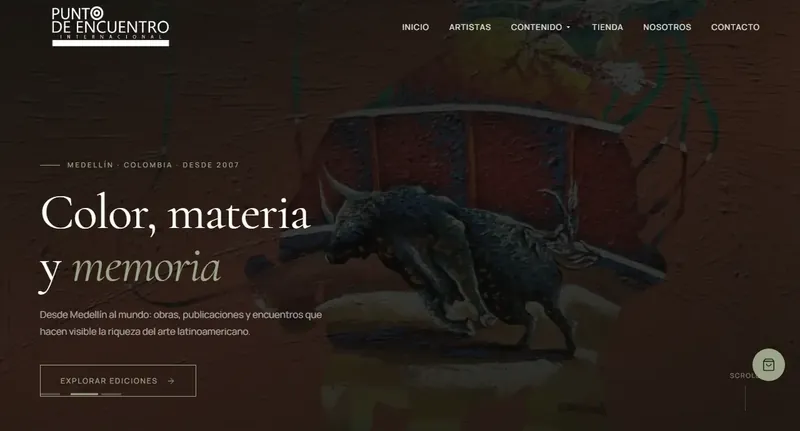 Punto de EncuentroCulture · Platform and store
05 Questions
Frequently asked questions about online stores.
Have another question? Message us and we'll reply the same business day.
Ask on WhatsAppDo I need a registered company to sell online?
Payment gateways ask for the seller's details and a bank account in their name, and some work with individuals. If you're going to invoice or grow, it's worth formalizing the business; your accountant can tell you which structure fits and what tax obligations you have.
Is offering cash on delivery worth it?
In Colombia many shoppers still prefer to pay on delivery, so it can boost sales. In exchange, you get more returns and orders nobody receives. Many stores offer it only in certain cities or up to a maximum amount.
What is the right of withdrawal?
For distance sales, Colombia's Consumer Statute (Law 1480 of 2011) gives shoppers up to 5 business days after delivery to change their mind, with some exceptions. Your store should state it clearly in its policies.
Can I sell only on WhatsApp, without a store?
Yes, many businesses do. The limit comes when orders grow: copying details by hand, confirming payments one by one and answering the same thing a hundred times. A store with orders that reach WhatsApp organizes that without losing the personal touch.
How much does an online store cost?
It depends on how many products you have, the platform, the payment, shipping and inventory integrations, and whether it includes an AI assistant. Blinq doesn't publish prices: we quote in writing after the free assessment. The payment gateway fee is charged separately on each sale.
Sources
Where the data comes from.
The figures and rules cited in this guide come from these sources. For your specific case, ask your accountant or a lawyer.
- WhatsApp in online stores
WhatsApp se consolida como aliado clave del comercio electrónico en Colombia (in Spanish), in Portafolio, on the Tiendanube report.
- Platforms
Shopify, Tiendanube and WooCommerce, on their official sites.
- Right of withdrawal
Law 1480 of 2011, article 47 (in Spanish), on the Colombian Senate’s site.
- Electronic invoicing
Electronic invoicing (in Spanish), on the DIAN’s site.
Shopify, Tiendanube, WooCommerce, WhatsApp and the other brands mentioned belong to their owners. Blinq is not affiliated with them.
Ready to sell online without losing WhatsApp?
We review your catalog and how you sell today, and tell you what store you need. Free, with no commitment.